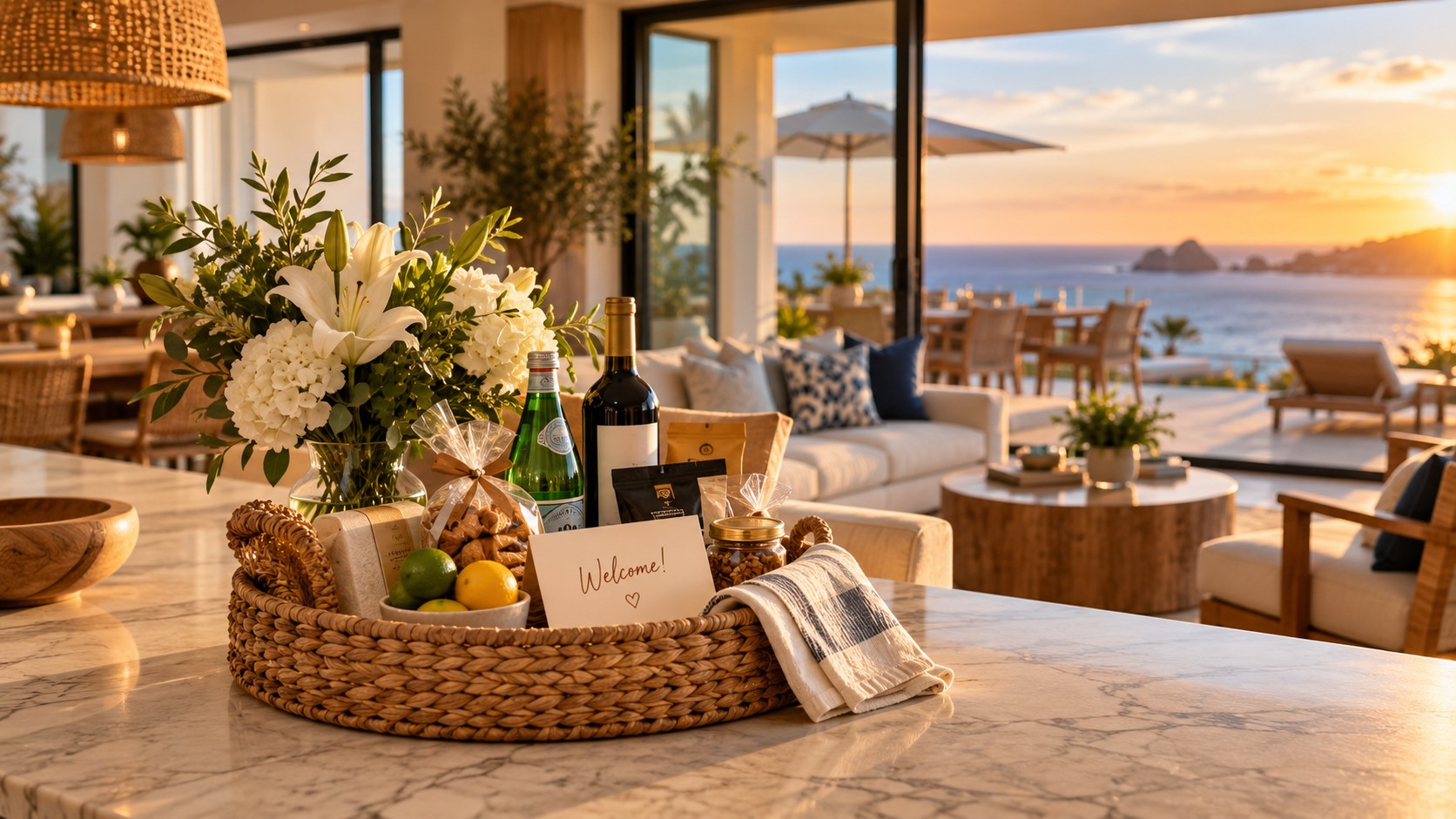
A bottle of water. A few locally made snacks. Fresh coffee for the morning. A handwritten note welcoming a family by name.
None of these things are particularly expensive.
But after a long flight, a delayed connection, a road trip with children, or hours spent navigating an unfamiliar destination, discovering something thoughtful waiting inside a vacation rental can immediately change how a guest feels about their arrival.
That is the power of a welcome gift.
For vacation rental hosts and property managers, welcome goodies are not about filling a giant basket with expensive products. They're about creating a small, unexpected moment that communicates something much more valuable:
We were expecting you. We're happy you're here.
And research in hospitality suggests that those moments can matter.
Why the First Few Minutes Matter
Think about the guest experience from the traveler's perspective.
They've spent weeks or months researching and planning their vacation. They've looked at photos, read reviews, made a reservation, paid for the stay, packed their bags and traveled — sometimes thousands of miles.
Then they finally open the door.
This is the moment when the vacation rental they imagined becomes real.
A clean, comfortable property is essential. But when guests also discover a thoughtful welcome waiting for them, the experience can move beyond simply meeting expectations.
It can create delight.
Hospitality researchers have described customer delight as something distinct from ordinary satisfaction: it occurs when an experience positively exceeds expectations.
A study published in the Journal of Travel Research analyzed hundreds of travel blogs containing descriptions of positive or delightful surprises in hotels, and found that customer service was the most frequently identified source of guest delight, followed by cleanliness. The study also noted the established relationship between delight, repurchase intentions, and positive word of mouth.
That's important for vacation rental operators.
The goal isn't necessarily to spend more money.
It's to create an unexpected moment of hospitality.
The Psychology Behind the Surprise
Imagine two nearly identical stays.
At Property A, the guest enters a perfectly clean vacation rental. Everything looks exactly as expected.
They're satisfied.
At Property B, the guest enters an equally clean rental but discovers a small basket containing bottled water, local snacks and a handwritten card:
"Welcome, Sarah & Michael! We hope you have an amazing anniversary trip."
The property itself hasn't changed.
But the experience has.
Research published in the International Journal of Hospitality Management compared surprise rewards with traditional membership discounts and found that surprise rewards could be more effective at increasing customer delight and satisfaction under the conditions studied.
Another hospitality study found that surprise can strengthen customer delight and positively affect loyalty intentions, although the researchers also cautioned businesses against turning an occasional surprise into something customers eventually expect every time.
That distinction is valuable.
The welcome gift works best when it feels like hospitality — not an entitlement.
Small Details Can Create Big Memories
Guests probably won't remember exactly how many coffee pods were in the kitchen.
They may remember that coffee was waiting for them when they woke up.
They may not remember what the chocolates cost.
They may remember discovering them after arriving late at night.
They may not keep your welcome card.
But they may remember seeing their name on it.
Research examining delightful hotel experiences has identified both tangible and intangible elements behind memorable guest moments — including property-related details, friendly service, professional service, and unexpected service.
More recent hospitality research continues to find connections between surprise, customer delight, and behaviors that benefit hospitality brands. One recent study of hotel guests found that surprise significantly enhanced customer delight and brand-supportive behavior, with an indirect pathway from surprise through delight toward stronger brand advocacy.
A separate large-scale study of hotel guests examined satisfaction, delight, and loyalty, and found that delight's influence on loyalty was particularly strong among first-time guests.
For a vacation rental host, that first stay may therefore be especially important.
You only get one opportunity to create a guest's first impression.
What Should You Leave for Guests?
There isn't one perfect welcome basket.
In fact, we prefer the term welcome experience because a basket isn't required at all.
The best welcome gift should reflect three things:
Your property. Your destination. Your guest.
A simple setup might include:
- Bottled water
- Coffee or tea
- Individually packaged snacks
- A local treat
- A handwritten welcome card
A beach rental could include sunscreen samples, bottled water and a locally made snack.
A mountain cabin might offer hot chocolate, coffee and cookies.
A family-oriented property could include popcorn, juice boxes and a small activity for children.
A luxury property could provide sparkling water, premium chocolates, locally sourced products or another elevated — but tasteful — touch.
Airbnb itself recommends small hospitality gestures such as handwritten notes, flowers, beverages, snacks and local products as ways hosts can make guests feel welcome, and specifically suggests customizing treats for different guests and asking about dietary restrictions when appropriate.
The important part isn't the price.
Thoughtfulness beats extravagance.
Local Products Make the Experience More Memorable
One of the best opportunities is to introduce guests to your destination immediately.
Instead of generic candy from a supermarket, consider something produced locally.
Depending on your market, that might be:
- Locally roasted coffee
- Regional chocolate
- Local cookies or pastries
- Small jars of honey or jam
- Locally produced snacks
- Tea from a nearby producer
- A small destination-themed souvenir
This accomplishes two things at once.
First, you're welcoming the guest.
Second, you're introducing them to the destination.
Airbnb specifically recommends local products as a way to support the surrounding community while helping guests feel more connected to the place they're visiting.
There's another advantage: local products tell a story.
And stories are memorable.
Personalization Makes It More Powerful
A generic card that says "Welcome to our property" is nice.
A card saying:
"Welcome, Jennifer! We hope you and your family have an incredible week in San Diego."
feels different.
The cost is identical.
The experience isn't.
Hospitality researchers studying personalization have found that effort and surprise are important components in whether guests actually perceive a service as personalized.
Personalization doesn't have to mean collecting large amounts of guest data.
Use information guests have voluntarily provided during the normal reservation process.
If they're celebrating an anniversary: "Happy Anniversary!"
If they're traveling with children: add a coloring book or small game.
If they're bringing a dog to a pet-friendly property: leave a few dog treats.
If they're arriving late: water and an easy snack may be far more valuable than decorative items.
The objective isn't to impress guests with how much you know about them.
It's to demonstrate that you paid attention.
Don't Forget Practical Goodies
Not every thoughtful amenity has to be exciting.
Sometimes the most appreciated items are the ones guests suddenly realize they need.
Consider keeping a small supply of:
- Toothbrushes
- Toothpaste
- Makeup remover wipes
- Feminine hygiene products
- Laundry detergent
- Dishwasher tablets
- Phone charging cables
- Coffee
- Tea
- Bottled water
Airbnb recommends that hosts anticipate guest needs by stocking essentials, and notes that experienced hosts often provide additional practical items such as power adapters, ear plugs, board games and destination-specific supplies.
A guest who discovers at 11:30 p.m. that they forgot their toothbrush may value a $1 toothbrush more than a $20 decorative gift.
That's hospitality.
Create Different Welcome Levels
If you manage multiple properties, don't improvise the welcome experience for every reservation.
Create a system.
For example:
Standard Welcome — Appropriate for shorter stays or moderately priced properties: water + coffee + small snack + welcome card.
Premium Welcome — For higher-value reservations: water + coffee + several snacks + local specialty + personalized card.
Celebration Welcome — For birthdays, anniversaries, honeymoons or other special occasions: your standard welcome plus a small celebration-specific item.
This makes the program scalable while allowing personalization when it matters.
You can also establish a maximum welcome cost based on the value of the reservation rather than using the same budget for every booking. A $10 gesture on a $600 reservation and a $50 gesture on a $7,000 reservation represent very different percentages of revenue. Treat it like a hospitality expense and budget accordingly.
Make It Operationally Simple
A great idea that your cleaning or operations team can't execute consistently isn't a great system.
Create a simple Welcome Kit Checklist for every turnover. Your checklist might include:
- Confirm guest name.
- Check reservation notes for celebrations or special circumstances.
- Check known dietary restrictions if food is being provided.
- Select the appropriate welcome package.
- Place items in the designated location.
- Add personalized card.
- Verify expiration dates.
- Photograph the completed setup if your operation requires quality-control documentation.
Keep commonly used products in inventory and establish minimum stock levels. For larger portfolios, assign SKUs or categories to different welcome packages so staff don't have to guess what belongs in each property.
Consistency matters.
Food Allergies and Dietary Restrictions Matter
Food is one of the easiest welcome gifts, but it also requires care.
Guests may have nut allergies, gluten intolerance, diabetes, religious dietary restrictions, vegan or vegetarian preferences, or other food sensitivities.
Whenever possible, use commercially packaged products with clear ingredient labels.
If you plan to provide something personalized, asking about dietary restrictions beforehand is a simple precaution — a practice Airbnb highlights in its own host guidance.
Also be cautious with alcohol. Not everyone drinks, and local regulations can differ. A premium sparkling water, specialty coffee or local nonalcoholic beverage can often provide the same feeling of hospitality without making assumptions about your guests.
Don't Use Goodies to Cover Up the Basics
This may be the most important rule.
A welcome basket cannot compensate for a dirty property, broken air conditioning, missing linens, poor communication, an inaccurate listing, complicated check-in, or maintenance problems.
The fundamentals come first.
Airbnb's host guidance emphasizes cleanliness, stocked basics, reliable check-in instructions, communication and accurate property preparation before suggesting special touches such as welcome gifts.
The goodies are the finishing touch.
They're the ribbon on the package — not the package itself.
Could Welcome Gifts Lead to Better Reviews?
This is where we should be careful with statistics.
There is currently limited high-quality research that isolates vacation rental welcome baskets specifically and proves that spending a certain amount produces a specific increase in star ratings. So claims such as "welcome baskets increase five-star reviews by 25%" should be treated skeptically unless they're backed by a clearly identified study.
What the hospitality research does support is the broader chain: an unexpected positive experience leads to guest delight, and guest delight is linked to stronger loyalty, positive word of mouth, and repeat intentions. Multiple hospitality studies have found relationships along this pathway.
Airbnb also advises hosts that thoughtful extras and welcome gifts can contribute to a welcoming experience and potentially help create the conditions for great reviews.
That doesn't mean a bag of cookies automatically earns five stars.
It means thoughtful hospitality can become one component of an experience worth five stars.
Measure Whether It Works
Don't simply assume guests appreciate your welcome program. Measure it.
Track how often welcome items are mentioned in reviews, guest messages mentioning the gift, overall review scores, repeat bookings, referral bookings, cost per reservation, and welcome cost as a percentage of reservation revenue.
After 50 or 100 stays, look at the data. You might discover that guests rarely mention an expensive product but constantly mention your handwritten notes.
That's useful information.
Spend more on what guests value. Spend less on what they don't.
Turn Hospitality Into Part of Your Brand
The best welcome experience shouldn't feel random.
It should feel like your brand.
A rustic mountain cabin, urban apartment, beachfront villa and luxury estate shouldn't necessarily offer the same welcome package.
Think about what you want guests to associate with your property. Relaxation? Local culture? Family? Luxury? Adventure? Wellness?
Then design the arrival experience around that identity.
A guest shouldn't think: "They left me some snacks."
Ideally, they should think: "These hosts really thought about my stay."
That's a much more powerful message.
Key Takeaways
Welcome gifts don't need to be expensive to be effective.
Hospitality research shows that unexpected positive experiences and personalization can contribute to guest delight, and guest delight has been associated with loyalty, repeat intentions and positive word of mouth.
The most effective welcome experiences are thoughtful rather than expensive, relevant to the destination, personalized when appropriate, useful to the guest, easy for your team to execute, and consistent with your property's brand.
And most importantly, they should complement — not replace — the fundamentals of great hospitality.
A clean property, accurate listing, responsive host and smooth check-in will always matter more than a basket of goodies.
But once you've mastered those basics? A $10 gesture can sometimes create a memory worth far more than $10.
Frequently Asked Questions
Should every vacation rental provide a welcome basket?
No. A welcome basket isn't required to provide a great stay. However, a thoughtful welcome gesture can differentiate the guest experience and create a stronger first impression.
How much should I spend on a vacation rental welcome gift?
There is no universal amount. The budget should make sense relative to your nightly rate, reservation value, property positioning and operating margins. Even an inexpensive handwritten note can create a personal touch.
What are the best goodies to leave for vacation rental guests?
Water, coffee, tea, packaged snacks and locally produced treats are simple choices. Practical forgotten essentials can also be extremely useful.
Should I personalize the welcome gift?
When practical, yes. Using the guest's name or recognizing a voluntarily disclosed birthday, anniversary or family trip can make an inexpensive gesture feel much more meaningful.
Should I leave alcohol for vacation rental guests?
Consider your guests and local regulations before providing alcohol. Nonalcoholic alternatives such as sparkling water, premium coffee, tea or local beverages can provide a welcoming experience without assuming guests drink alcohol.
References
The statistics and research in this guide were compiled from publicly available reports and research published by:
- Magnini, V. P., Crotts, J. C., & Zehrer, A. (2011). Understanding Customer Delight: An Application of Travel Blog Analysis. Journal of Travel Research, 50(5), 535–545.
- Investigating the Impact of Surprise Rewards on Consumer Responses. International Journal of Hospitality Management, Volume 50, 2015, pp. 27–35.
- Customer Delight: Universal Remedy or a Double-Edged Sword? Journal of Service Theory and Practice, 27(1), 2017, pp. 22–45.
- Lee, S. A., & Shea, L. (2015). Investigating the Key Routes to Customers' Delightful Moments in the Hotel Context. Journal of Hospitality Marketing & Management, 24(5), 532–553.
- Selmi, N., Chaney, D., Haq, M. D., & Mesana, J. C. B. (2026). From Surprise to Evangelism: The Sequential Roles of Delight and Brand Defense in Hospitality. Journal of Hospitality and Tourism Management, Volume 66.
- Kim, M., Knutson, B. J., & Vogt, C. A. (2014). Posttrip Behavioral Differences Between First-Time and Repeat Guests: A Two-Phase Study in a Hospitality Setting. Journal of Hospitality Marketing & Management, 23(7), 722–745.
- Airbnb. Going Above and Beyond to Welcome Your Guests. Airbnb Resource Center.
- Recipe for Perceived Personalization in Hotels. Tourism Management, Volume 100, 2024.
- Airbnb. Prepare Your Space. Airbnb Resource Center.
Always refer to the original publications for the most current methodologies, regional breakdowns, and updated figures.
About MyVRP
Memorable hospitality doesn't stop at check-in.
MyVRP helps independent vacation rental hosts and property managers create a more professional guest experience — from showcasing their property portfolio to organizing reservations, communicating with guests and giving travelers access to helpful information throughout their stay.
The technology should make hospitality easier.
The human touches are what make it memorable.
Build a better guest experience with MyVRP.
From first click to five stars — start today.
Showcase beautifully. Manage effortlessly. See it for yourself.
Start your free trial →